Did you know…

By age three, the brain has formed about 1,000 trillion synapses, which is twice as many as adults. As the synapses in a child’s brain are strengthened through repeated experiences, connections and pathways are formed that structure the way a child learns. If a pathway is not used, it’s eliminated based on the “use it or lose it” principle. Things that a child does only once will have very little influence on brain development. When a connection is used repeatedly in the early years, it becomes permanent.

Read Read Read to your kids!

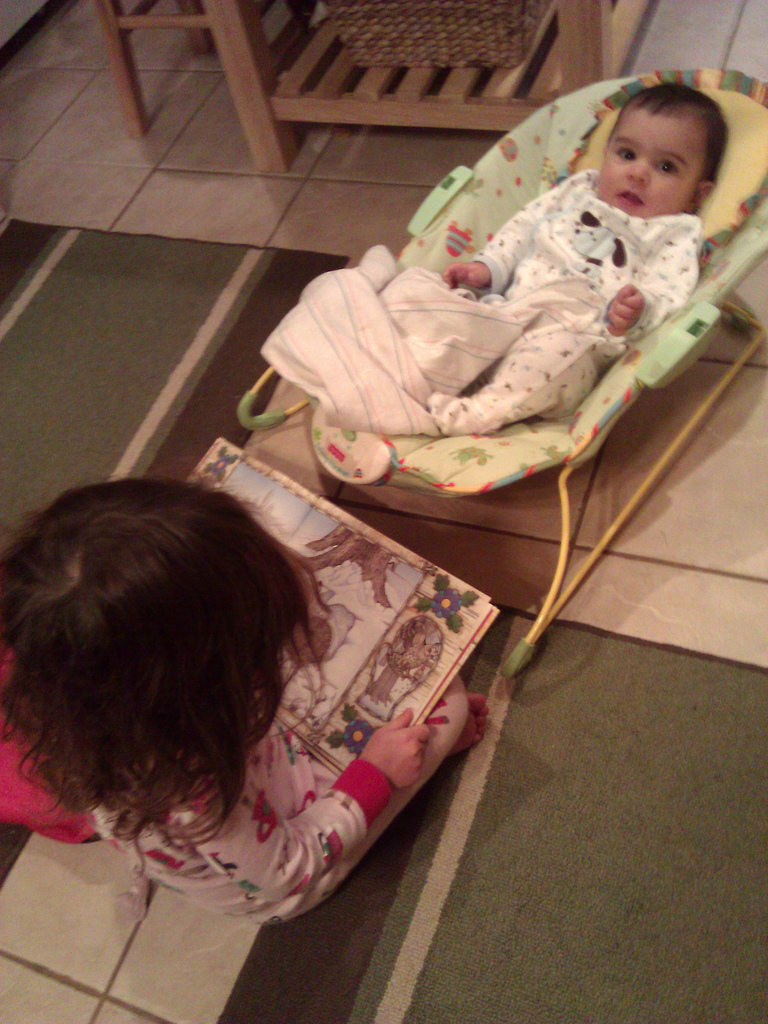
Miss H reading to Mr. M

I brought home a book from my office that we haven’t read with the kids before (The Mitten by Jan Brett). I told Miss H that we would read it after breakfast. She asked to hold it and said “Mommy I’m going to read it first.” She then sat down on the floor in front of her little brother in the bouncy seat and began to “read” the book to him. And what a story it was! It was a story of animals and snow and some made up words in between. Mr. M watched and listened intently, and added his own “words” when he felt it was necessary. They created their own “Shared Book Experience” all on their own.

Parent PhD is back in action…

After taking a very important maternity leave with Baby M, Parent PhD is back in action. Continue to check back for information about young children for schools, parents and caregivers. It’s going to be a great year!

- Dr. Jenn

What do you think?

While out to dinner last night my husband and I saw 2 different preschool-age children out to dinner with their parents. One was given a portable DVD player to watch and the other was given an iPad to play games on while at the table. Both were immediate – not responses to either child misbehaving or getting restless. What are your thoughts on this?

Some Tips for Understanding and Responding to Newborns and Young Infants

Baby M - 2 weeks old

On May 24th our family happily welcomed Baby M. The past 3 weeks have been wonderful as we watch him get acclimated to the world, our family and especially his big sister Miss H. Every day I am reminded of both how amazing infants are and how important it is to meet their needs . When we meet infants needs and understand them, they learn to trust the world. This trust is the building block for the rest of their learning and development.

A little reminder about talking to and interacting with young children…

“Early experiences can determine how proficient a child becomes in his or her native language. Researchers found that when mothers frequently spoke to their infants, their children learned almost 300 more words by age 2 than did their peers whose mothers rarely spoke to them. Furthermore, studies have suggested that mere exposure to language such as listening to the television or to adults talking amongst themselves provides little benefit. Rather infants need to interact directly with other human beings, to hear people talking about what they are seeing and experiencing, in order for them to develop optimal language skills. Unfortunately, many parents are under the mistaken impression that talking to babies is not very important because they are too young to understand what is being said.” (www.zerotothree.org)

Prop Boxes in Early Childhood Classrooms

The Vet Prop Box

“Prop Boxes” are essentially a box full of materials related to the same theme or topic. The children play with the materials, act out scenarios related to the theme and add the materials to their own play. When using Prop Boxes in my own preschool classroom, I found that not only was the children’s play enhanced by using the materials, but their language and social interaction also increased. The children were eager to use the materials in their play and to represent the theme in the purest way possible. 

Sensory Bottles and Sensory Bags – Let’s Talk Perception!

WP_000391

Perception is the first area of development that any parent or caregiver of infants and toddlers should learn about. By now we know that infants and toddlers learn by exploring with their five senses. Sensory experience links to motor development and early sensorimotor experience provides the basis for cognitive development. Perception is the ability to take in and organize all of these sensory experiences. Sensory Integration is the process of combining and integrating information across the senses. It is critical to the development of perception and helps children apply information learned from one sense to another sense.

Caregivers and Caregiving

4451835271_02aee073a8_b

As infant/toddler educators, we call our teaching “caregiving” because we are “caring” for the children. This goes beyond “teaching” them. Therefore throughout this series you will see teachers referred to as “caregivers” and teaching referred to as “caregiving.”

Climbing the Ladder and Flipping the Light Switch

5217266371_af9ac3114f_b

Parent PhD’s Infant/Toddler Series will focus on understanding and learning how to appropriately respond to infants and toddlers. The series serves many purposes and populations.

Powered by WordPress | Designed by: WordPress Themes | Thanks to best wordpress themes, Find WordPress Themes and Themes Directory